


The stones, when they do not belong to a privileged category such as gemstones, are ignored, stepped on with indifference and unawareness. They lie on the ground, wet from the rain, warmed by the sun, kicked by passersby, subjected over millennia to the movements of the earth that determine their position.
If you think about it, every stone, even the most insignificant one, is worthy of attention. It has its own identity, a history spanning millions of years that reflects the geological story of the place where it is found.
The minerals that compose it determine its appearance and texture.
Stones, rocks, mineral formations are living ecosystems.
Stones are living organisms.
They are the complex environment of trans-species interdependence in which the living and the mineral become indistinguishable. [1]
In Aboriginal cultures, stones are considered entities that breathe and, like reptiles, shed their outer skin over time, in life cycles in which the mineral interacts with the atmospheric, the earth, the water, and the air. [2]
In the Quechua and Aymara traditions, stones are nourished as part of rituals during which their surfaces are rubbed with llama fat and blood, practices in which the stones are fed like living beings. [3]
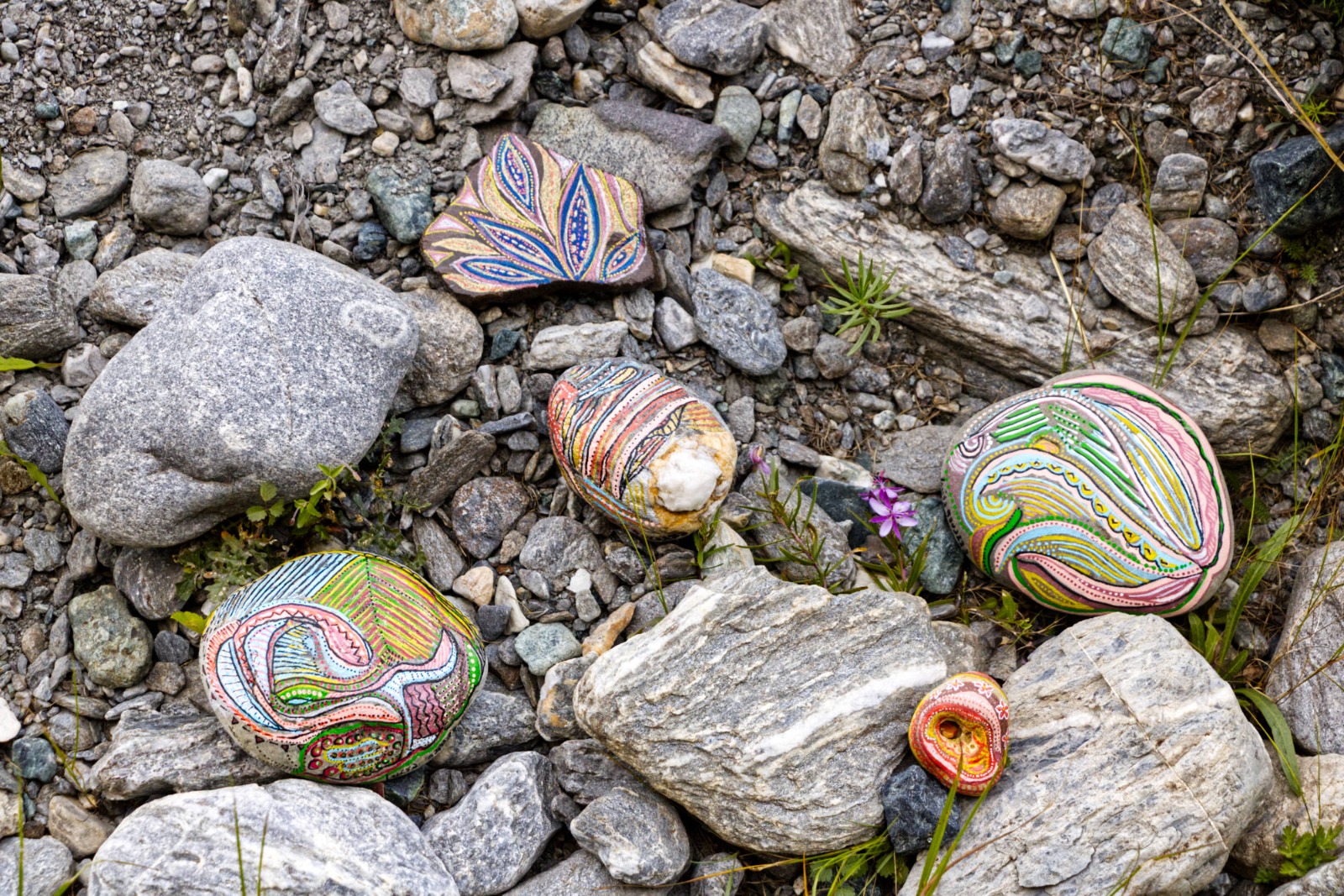
Using acrylic paints, I have experimented with the most varied and unpredictable results on this material, which appears static and immutable yet is very versatile.
Rough and irregular stones turned out to be perfect for achieving layered and shaded colors, while the smoother and more uniform ones are ideal for precise marks and evenly distributed colors.
For me, painting them is an act of beautification, a form of redemption.
Stones are a metaphor for a forgotten and abandoned humanity for which I dream of a rebirth, a new and unprecedented form of recognition.
The Litometamorphosis project, in addition to the stones themselves, also includes photographs of the stones and the publication of a collection of poems dedicated to those who suffer injustice, violence, and marginalization. The proceeds from the sale of the book, the painted stones and the photographs will be donated to APS Cascina Macondo for Its social projects that always aim to promote inclusion and to involve people facing difficulties and those with disabilities. This Association also runs artistic projects aimed at a wide and diverse audience in Italy and abroad.
The stones I have painted come from various places.
Some come from the beaches of Liguria and the mountain paths of Piedmont, and I collected them myself.
Many were given to me by my brother Giuseppe, who brought me stones from the Svalbard Islands, from Morocco, from Normandy, and from the beaches of Folkestone, a town in the southeast of England.
Those from Longyearbyen (Svalbard) are the result of core sampling, therefore they have a cylindrical shape.
The stones from Morocco are very dark and smooth, or lighter in color and rough.
The Norman ones are thin slate slabs, remnants of some construction.
The stones from Folkestone are rounded, and many have natural holes created by small mollusks that burrow into the stone to seek shelter. According to Nordic cultures, these perforated stones are a gift from nature and are considered a kind of natural talisman that protects against illnesses and evil spirits and brings luck and prosperity.
I would therefore like to thank my brother, who actively collaborates in finding the raw materials for my project and has given me much advice on how to present it.
I am also very grateful to my husband Maurizio, who helped me find the best places to take the photographs, patiently photographed the stones, and devoted many hours to post-production. His advice has always guided me toward achieving the best possible results.
On 29 March 2026, the project was presented at Cascina Macondo and I ran a stone painting workshop.
On May 24, 2026, as part of Cascina Macondo’s “Approdi Creativi” festival, I took part in a wonderful afternoon featuring theater, poetry, art, and music with my project. First presented was “Domus é,” curated by Nagi Tartamella and Florian Lasne (Compagnie Racines de Poche), who brought to the stage the actors and actresses of the inclusive theater company “Viaggi Fuori dai Paraggi” from APS Cascina Macondo, featuring Nagi Tartamella, Florian Lasne, and Anna Verrastro. This was followed by my presentation of Litometamorfosi, and finally, the concert by the ASAI “Bernardo Ascoli” Choir, conducted by Marco Ravizza, who performed songs of struggle and traditional folk songs.
[1] (Stonelife, the Microboplanetary Architecture of Lithoecosystems, Andrés Jaque, Gokce Ustunisik, Venice Biennale 2025)
[2] (Elizabeth Povinelli Do Rocks Listen?, Deborah Bird Rose Reports from a Wild Country: Ethics for Decolonization; Tyson Yunkaporta Sand Talk: How Indigenous Thinking Can Save the World)
[3] (Silvia Rivera Cusicanqui Ch'ixinakax utxiwa; Marisol de la Cadena Earth Beings: Ecologies of Practice Across Andean Worlds)
SEE ALL THE STONES IN MY PROJECT
The proceeds from the sale of the book, the painted stones and the photographs will be donated to Cascina Macondo, which runs artistic projects aimed at a wide and diverse audience in Italy and abroad. Its social projects always aim to promote inclusion and to involve people facing difficulties and those with disabilities.
On 29 March 2026, the project was presented at Cascina Macondo and I ran a stone painting workshop.